There are four different types of lunar surfaces. There is the Mare surface, the Craters, the Rills, and the Regolith. The Mare is the dark areas on the moon which are smooth and give off less light. The Craters are just that. Bowl shaped depressions on the moon surface (which get there by meteors crashing into the surface). The Rills are long, deep channels left by the lava flow of the Mares. Lastly, the Regolith is a surface covered by dust and rocks, the most common on the moon.
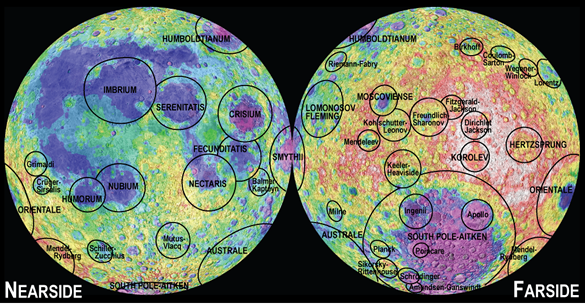
There are also three different layers of the moon. The first one is the crust. It is the nearest side to us and faces us. It is 60 km thick. The far side is about 100 km. thick. Below the crust is the mantel which is made up of rock that is rich in silca, magnesium, and iron. The mantel is also the largest layer of the moon. And lastly is the core or the middle of the moon. Which is made up of iron.
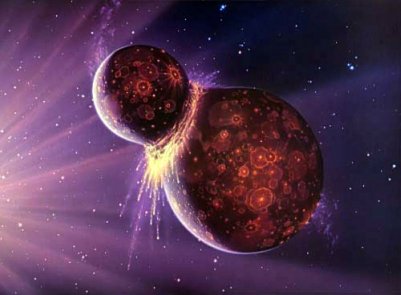
Scientist have three different theories of which the moon was formed. The first, the Giant Impact Hypotheisis, is that a large object crashed in Earth more than 4 billion years ago (they sudjest that the object was as big as mars) and the chunk that flew off of the earth, was pulled back, by the earths gravitational pull, and started to orbit the earth. The second theory, The Differation Of The Lunar Interior, the scientists believe that the moon was covered with molten rock and over time the densest materials moved toward the center of the moon and formed a small core, while the least dense materials moved to form the crust. The last theory, Meteorite Bombardment, scientists believe that the moon cooled down to form a thick solid crust over the molten inferior. At the same time debris left over from the formation of the solar system struck the solid surface and produced solid craters and Regolith.
The most interesting part about the section was that lava once flowed on the moon. Also the fact that there are different surfaces on the same moon is quite facinating.
